B2B Supplier Guide for Tailored SiC Ceramic Products | Sicarbtech Turkey 2025 Pillar Page
Compartilhar
Sicarbtech is the Silicon Carbide Solutions Expert trusted by Turkish textile, automotive, and aço manufacturers that demand durable, audit-ready ceramics engineered for severe duty. Based in Weifang City—China’s silicon carbide manufacturing hub—and a member of the Chinese Academy of Sciences (Weifang) Innovation Park, we bring more than a decade of customization experience spanning R-SiC, SSiC, RBSiC, and SiSiC. In 2025, as Turkish plants weigh energy tariffs, EU-aligned compliance, and delivery reliability, tailored silicon carbide components help stabilize processes, reduce downtime, and deliver measurable ROI.
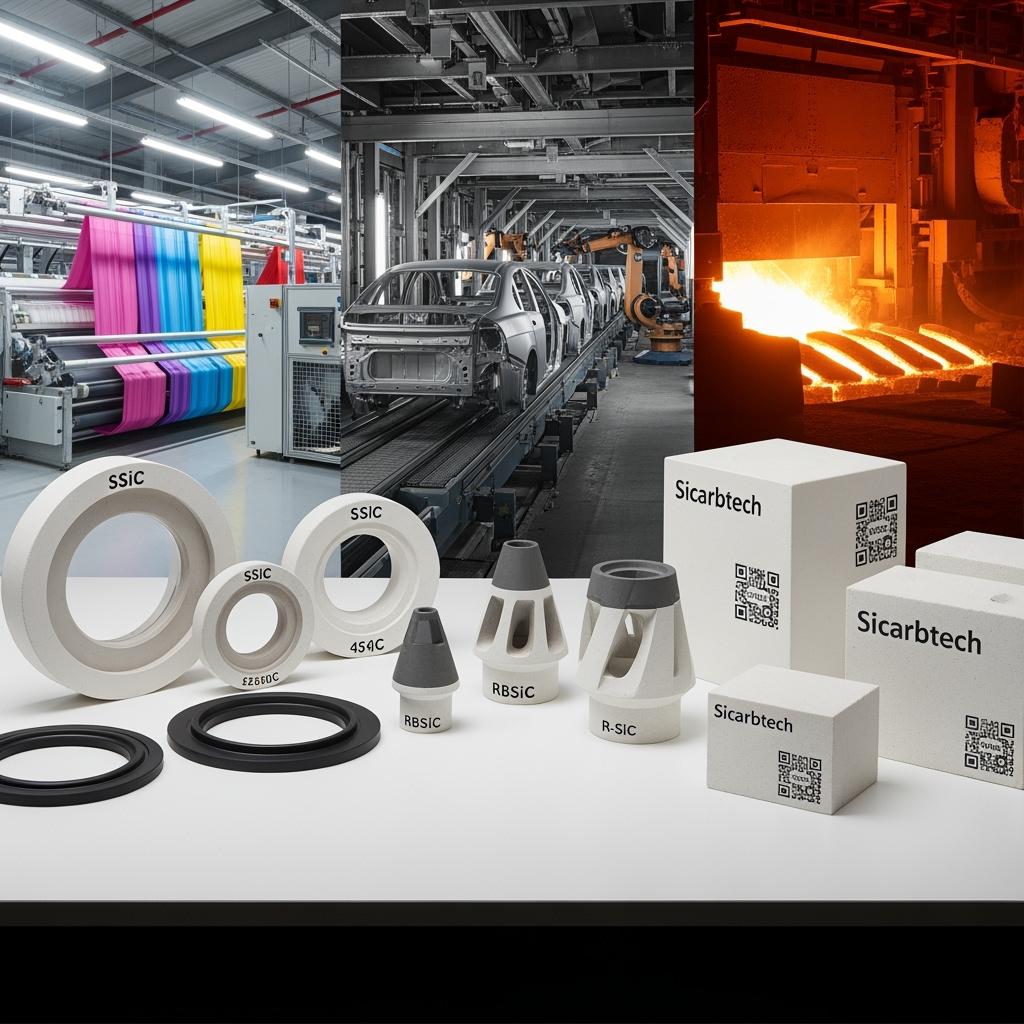
Executive Summary: Tailored Silicon Carbide Ceramics for Turkey’s 2025 Manufacturing Goals
Turkey’s industrial base is tightening process capability while competing on energy efficiency and export-grade quality. Textile hubs in Denizli and Gaziantep are under pressure to lower fabric defects and reduce chemical-driven stoppages. Automotive clusters in Bursa and Kocaeli are maintaining IATF 16949 rigor as EV-adjacent programs expand. Steel producers across Marmara and Iskenderun are optimizing thermal profiles under harsher cycling and environmental reporting demands. In this landscape, tailored silicon carbide (SiC) ceramics—designed around real duty cycles—become a strategic lever.
SSiC delivers near-theoretical density for high strength and corrosion resistance in seals and precision rollers. SiSiC and RBSiC offer complex, thermally robust geometries for burner nozzles, furnace elements, and heat-exposed fixtures. R-SiC reduces mass and tolerates rapid thermal shock, improving ramp times in ovens and furnaces. Moreover, Sicarbtech’s turnkey technology transfer and factory establishment services provide a path for Turkish firms to localize critical SiC capability, curbing FX exposure and stabilizing lead times. As Dr. Elif Taner, an industrial materials advisor, notes, “When SiC is co-engineered with the process—rather than inserted as a like-for-like swap—the line gains a wider window and shrinks both energy and quality variance.” (Source: Industrial Materials Forum notes, 2024)
Industry Challenges and Pain Points for Turkish B2B Buyers
Procurement leaders in Turkey face intertwined constraints that magnify the cost of inconsistency. Textile finishing lines operate in corrosive, abrasive environments, where conventional alumina rollers or coated metals roughen and warp, turning minute runout into visible fabric artifacts. Each stop multiplies costs: idle labor, partial batch losses, reheating energy, and expedited shipments to preserve export commitments. Under ISO 9001 and ISO 14001 oversight, every deviation becomes paperwork—CAPAs, root-cause analyses, and auditor follow-ups.
Automotive plants add precision to the equation. Heat-resistant steels and standard carbides in fixtures and seals creep or shift across thermal cycles, eroding process capability indices that underpin IATF 16949 programs. Deviations carry heavy administrative burdens—containment plans, PPAP updates, and quarantined lots—alongside the maintenance bill. FX swings compound pain; frequent imported spares become line items that are difficult to forecast in TRY, especially when emergency lead times stack up.
Steel furnaces operate at the harshest edge: flame impingement, slag corrosion, oxidation, and repeated thermal shock. Burner nozzles and skid elements degrade, distorting flame profiles and elevating fuel consumption. Unplanned replacements ripple through safety plans and campaign schedules. Simultaneously, reporting to the Ministry of Environment, Urbanization and Climate Change, aligned with EU norms and EN materials standards, expects measurable, auditable improvement—not just anecdotal claims.
The supplier landscape adds uncertainty. Some vendors can deliver parts, but few can combine material science, application engineering, and documentation that satisfies Turkish audits. As Prof. Murat Korkmaz, a metallurgical auditor, observes, “In 2025, what wins a supplier contract is not a glossy datasheet but a coherent evidence trail—properties, tolerances, traceability—and a plan to localize risk.” (Source: Istanbul Industry Audit Roundtable, 2024)
Building on this, buyers are recalibrating evaluation criteria. They want parts that extend life and stabilize energy consumption, but they also want vendor-managed inventories, local partners for customs and service, and credible paths to onshore production when the volume or risk profile justifies it. This is where a turnkey silicon carbide partner differentiates—by showing measurable gains on the line, proof for auditors, and concrete steps toward supply security.
Advanced Silicon Carbide Solutions Portfolio for Turkish Industry
Sicarbtech’s portfolio addresses these pain points with co-engineered, traceable silicon carbide solutions. In textile finishing, SSiC guide and spreader rollers are precision-ground to maintain low runout across long spans, minimizing fabric marking while stabilizing line tension. Bearing seats are lapped for repeatable installation, and surface finishes are tuned to fabric and dyestuff behavior. In corrosive spray and jet areas, SiSiC and RBSiC nozzles preserve flow geometry through rapid thermal transitions.
Automotive lines benefit from SSiC mechanical seals and pump components that maintain geometry through heat cycles, protecting paint uniformity and sealing integrity. R-SiC kiln furniture reduces thermal mass in paint-curing ovens, improving ramp uniformity and cycle time. In steel furnaces, SiSiC burner nozzles and RBSiC skid elements withstand flame and slag exposure, stabilizing heat profiles and extending campaign lengths.
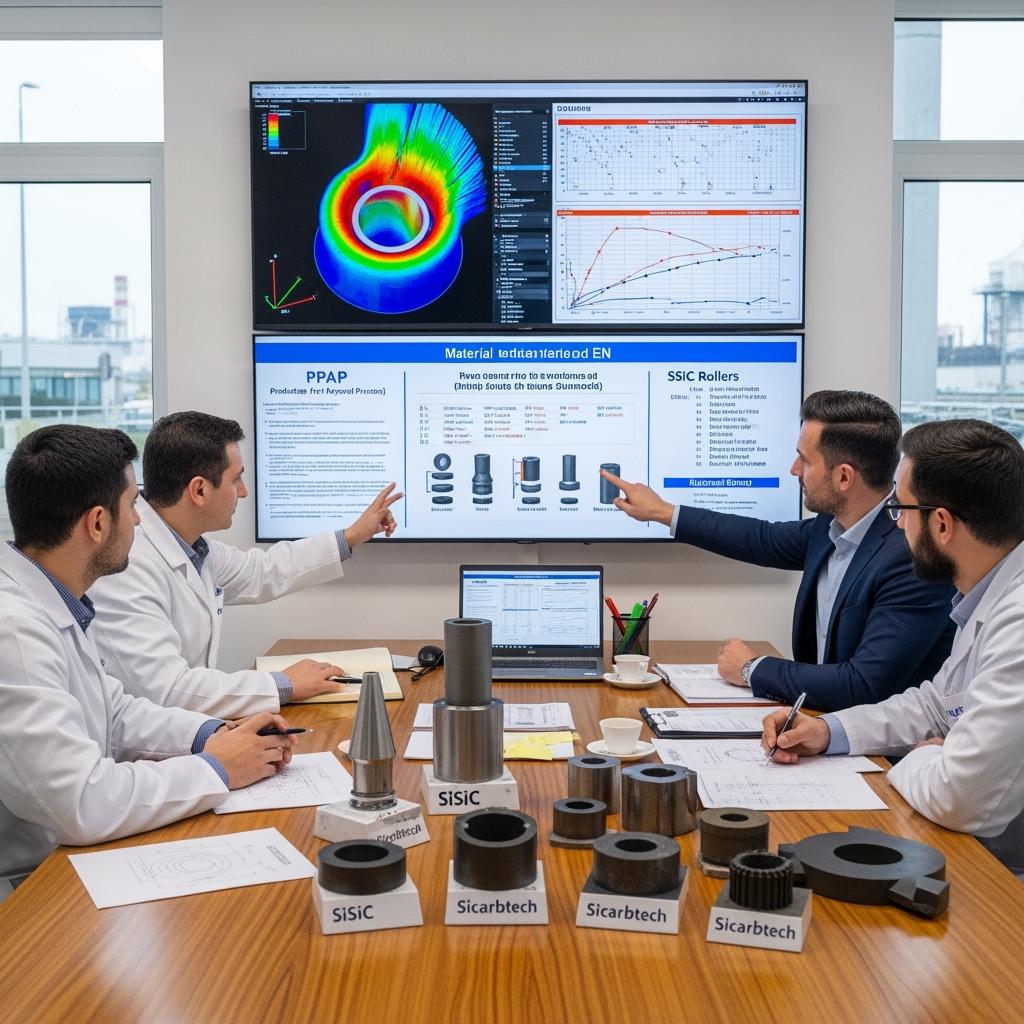
Every solution is backed by application engineering. Finite element analysis identifies thermal and mechanical stress concentrations; computational fluid dynamics optimizes burner and nozzle flows; and DFM reconciles geometry with manufacturability. We deliver with documentation—test certificates, dimensional reports, and EN-referenced property data—to streamline qualification and audits.
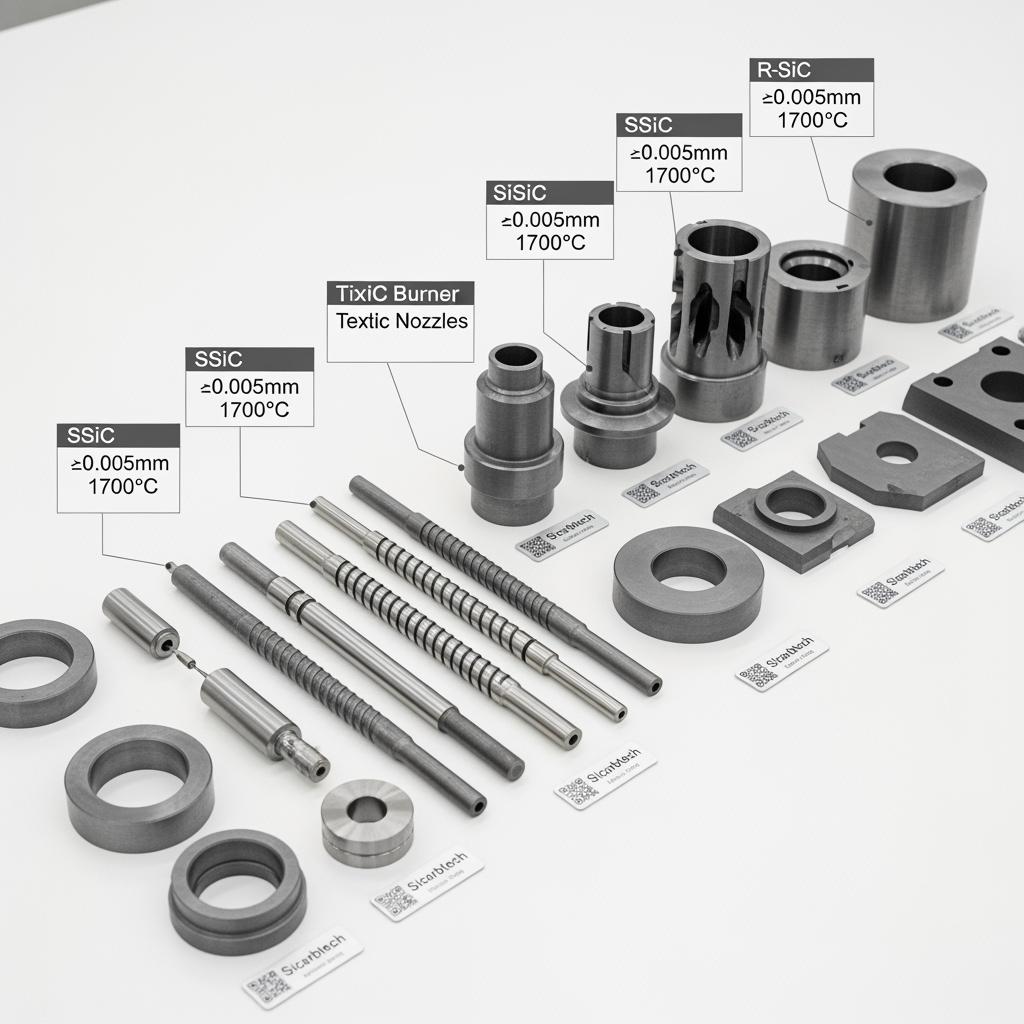
Performance Comparison: Tailored SiC Ceramics vs Traditional Materials
Engineering Benchmarks for Textile, Automotive, and Steel Duty Cycles
| Property / Metric | SSiC (sintered) | SiSiC / RBSiC (reaction-bonded) | High-Alumina Ceramic | Heat-Resistant Steel (EN 1.4841) |
|---|---|---|---|---|
| Max service temperature in air (°C) | 1,600–1,700 | 1,350–1,450 | 1,400–1,600 | 1,000–1,100 |
| Thermal conductivity at 25°C (W/m·K) | 100–160 | 60–130 | 20–35 | 15–25 |
| Coefficient of thermal expansion (10⁻⁶/K) | 4.0–4.5 | 4.0–4.8 | 7–8 | 16–18 |
| Flexural strength at RT (MPa) | 350–450 | 250–360 | 150–300 | 200–300 |
| Oxidation/corrosion resistance | Excelente | Çox yaxşı | Bom | Justo |
| Resistência ao choque térmico | Excelente | Çox yaxşı | Moderado | Moderado |
| Typical textile roller life (months) | 18–36 | 12–24 | 6–12 | 3–9 |
| Typical burner nozzle life (months) | 12–24 | 9–18 | 6–12 | 3–6 |
The combination of low thermal expansion and high thermal conductivity allows SiC parts to run closer to design intent, reducing hot spots and mechanical drift. On Turkish lines, this typically shows up as shorter ramps, steadier quality metrics, and fewer maintenance stops.
Real-World Applications and Success Stories from Turkish Plants
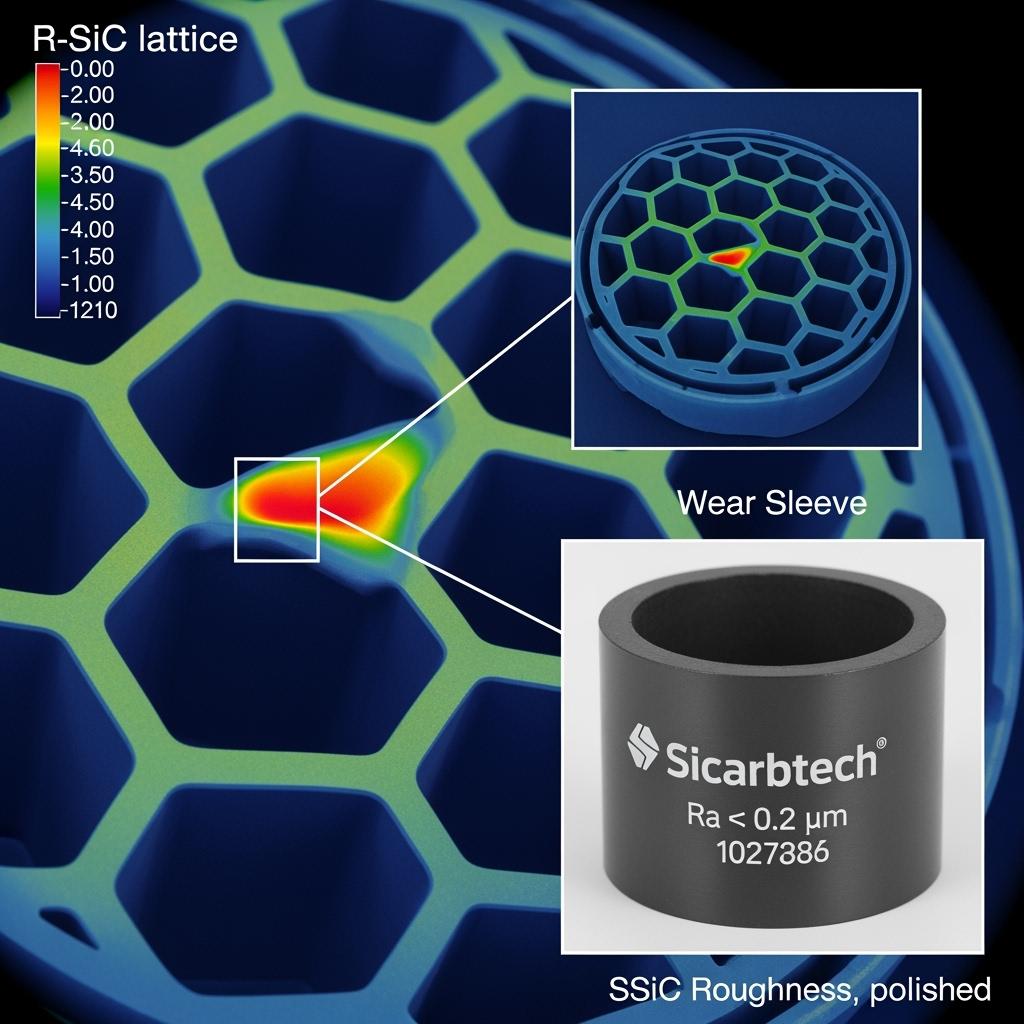
A Bursa Tier-1 automotive supplier worked with Sicarbtech to replace steel-heavy oven fixtures with R-SiC lattice designs and SSiC wear sleeves. Thermal mass decreased and heat distribution improved, cutting cycle time by 6–8% and reducing paint thickness variation. Rework declined by 21% over two quarters, and PPAP documentation updates were completed with less friction due to traceable inspection data.
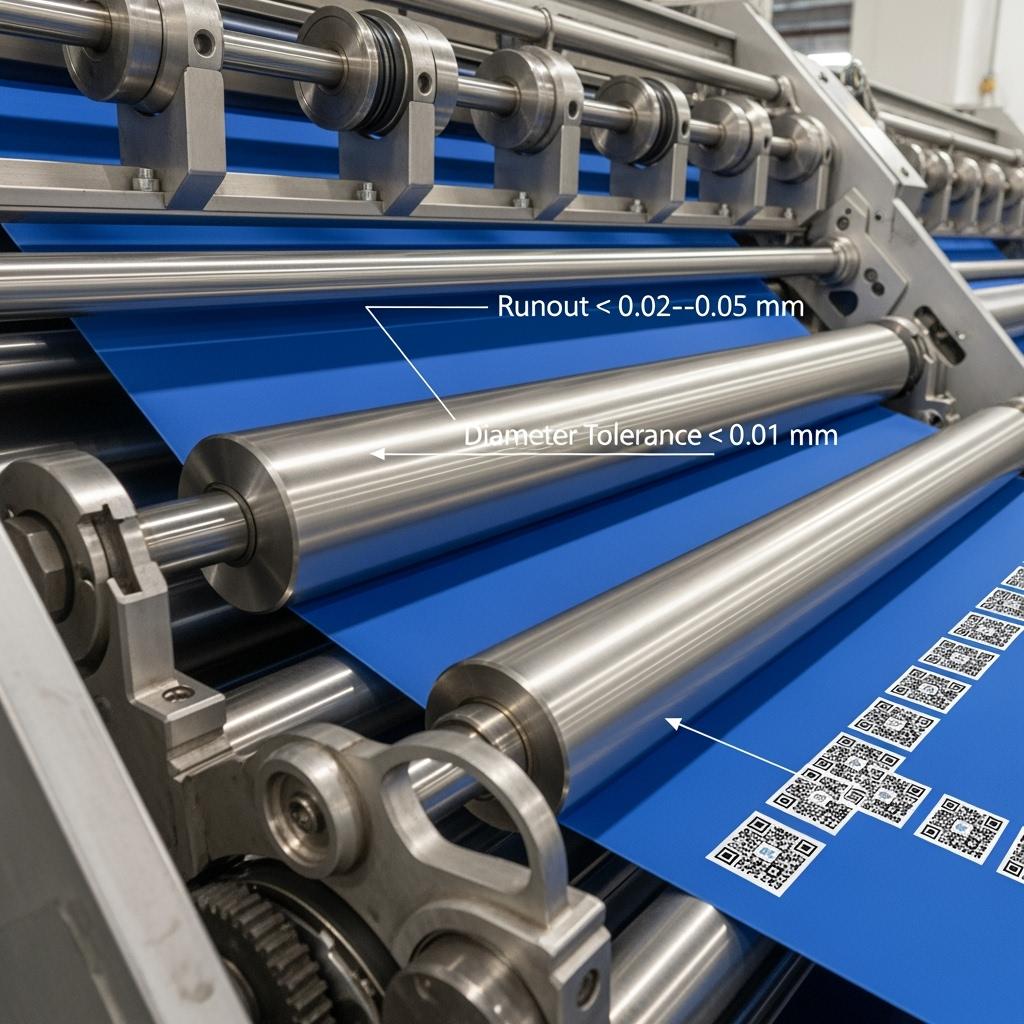
In Denizli, a textile finisher replaced alumina rollers with SSiC precision-ground rollers engineered for low runout and corrosion resistance. Over six months, roller changeouts halved and defect complaints tied to roller artifacts fell by 28%. ISO 9001 audits flagged fewer corrective actions thanks to improved process capability indices and serialized metrology.
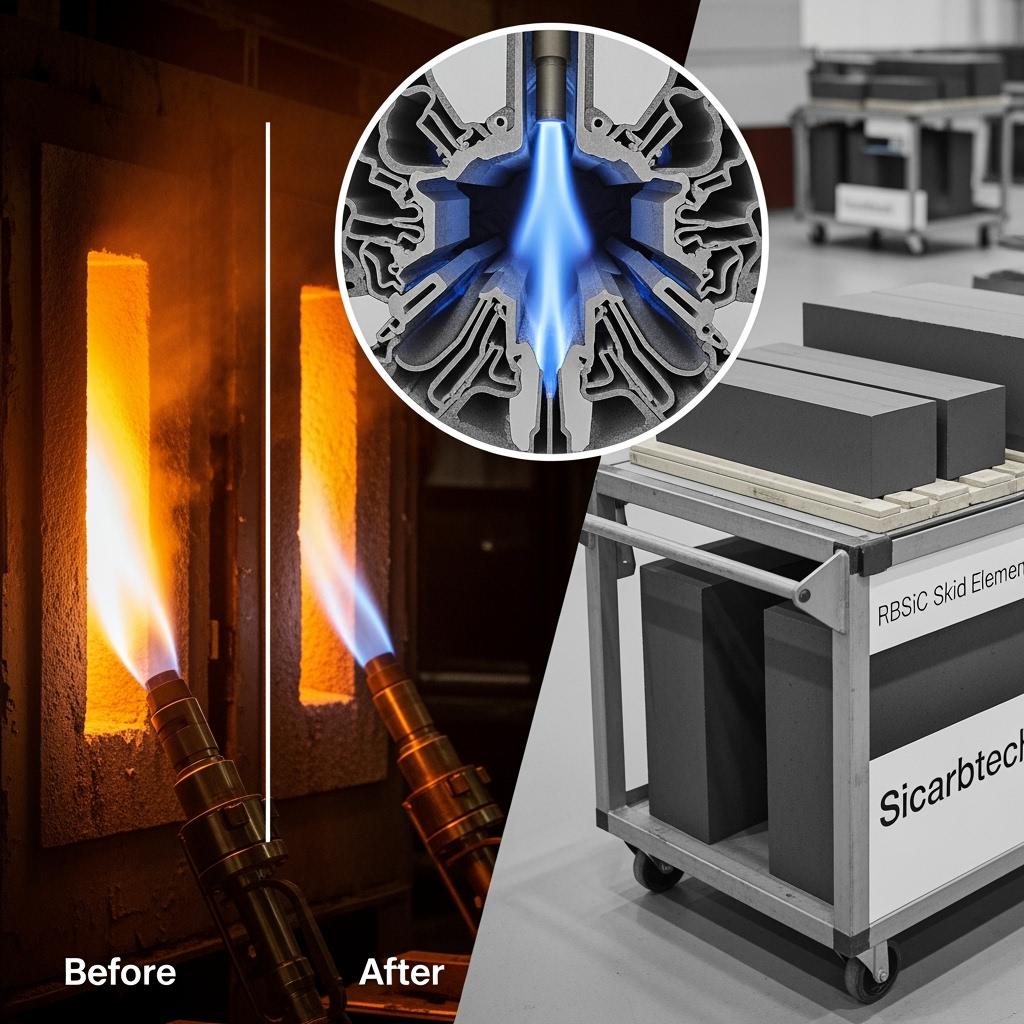
A Marmara steel producer introduced SiSiC burner nozzles and RBSiC skid elements. Flame patterns stabilized and nozzle replacement intervals extended from monthly to quarterly. After tuning, energy per ton dropped by about 15–20%, and thermal shock incidents fell sharply across two campaign cycles.
Technical Advantages and Implementation Benefits with Turkish Compliance
Silicon carbide’s covalent lattice yields high thermal conductivity, low thermal expansion, and strong chemical inertness—properties that directly translate into steadier processes. SSiC, with near-theoretical density, delivers top-tier strength and corrosion resistance for precision seals and rollers. SiSiC and RBSiC support complex geometries, combining strong thermal shock resistance with good creep behavior. R-SiC reduces mass without sacrificing shock tolerance, ideal for rapid-ramp furnaces and ovens.
Sicarbtech’s deployments align with Turkish compliance requirements. We support ISO 9001 and ISO 14001 documentation flows, reference EN material standards in data sheets, and provide CE-related inputs where SiC components integrate into machinery. For automotive-linked operations, we prepare PPAP-aligned records for IATF 16949. As Selim Öz, a quality systems auditor, puts it, “What convinces an auditor is stable performance plus a clear evidence chain—properties, dimensions, process controls—tied to serial numbers.” (Source: Auditor Interview Series, 2024)
Usługi produkcji na zamówienie i transferu technologii
Sicarbtech’s advantage is comprehensive: we supply premium SiC components and, where strategic, help Turkish partners build local capability end to end.
Our advanced R&D—reinforced by the Chinese Academy of Sciences (Weifang) Innovation Park—anchors proprietary processes for R-SiC, SSiC, RBSiC, and SiSiC. We specify powder chemistries and particle-size distributions; enforce contamination control in milling and dispersion; and select forming routes including cold isostatic pressing, slip casting, extrusion, and additive green-body strategies. Debinding and sintering cycles are tuned to achieve target density, grain size, and residual silicon control. Precision finishing relies on diamond grinding and lapping to deliver tight tolerances and surface finishes that resist crack initiation and abrasion.
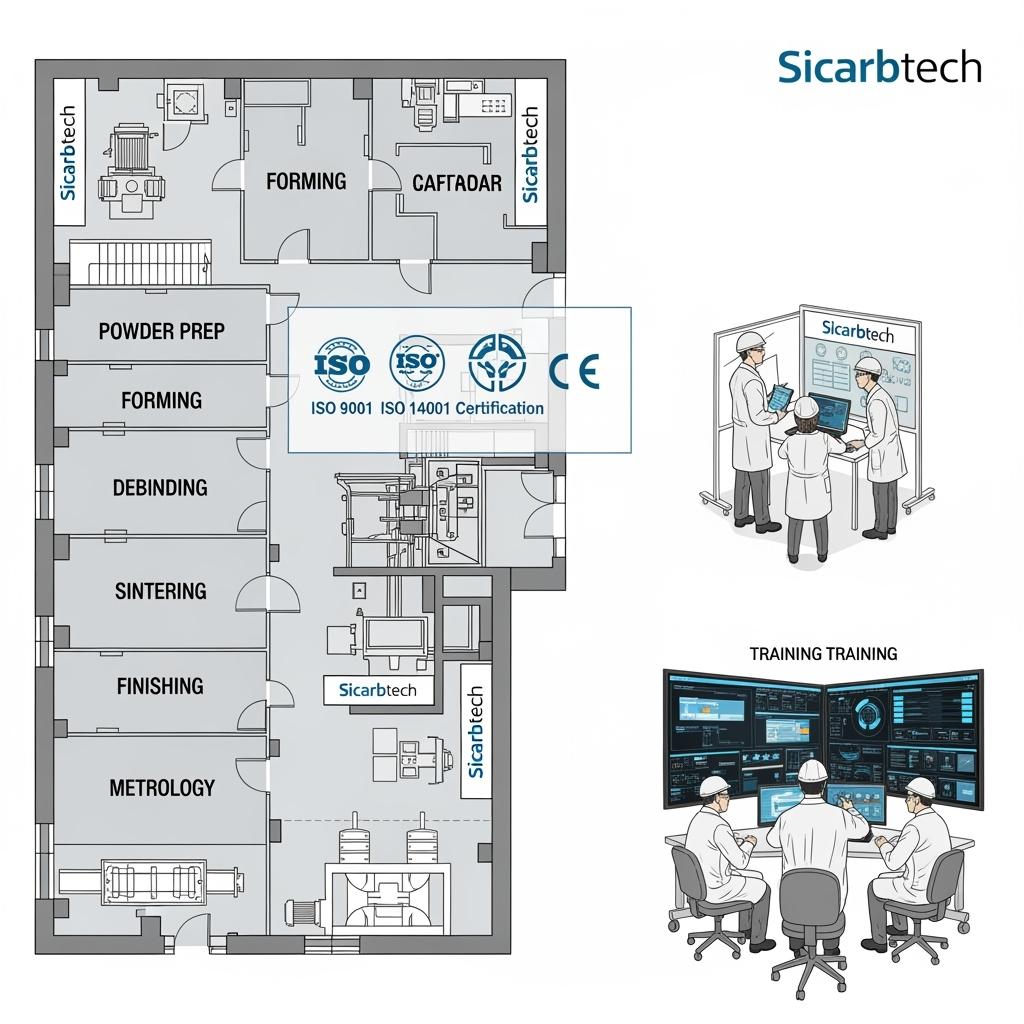
For partners pursuing localization, we provide complete technology transfer packages. These cover process know-how, equipment specifications (lined mixers, isostatic presses, clean kilns, handling fixtures), and metrology suites for thickness, flatness, roughness, and geometry. We deliver structured training for operators, process engineers, maintenance, and QA teams. Our factory establishment services begin with feasibility studies based on Turkish textile, automotive, and steel demand, then advance through layout design, utilities and HSE planning per local regulation, vendor selection, installation supervision, pilot runs, MSA, and commissioning.
Quality control is embedded from day one. We align with TS EN and ISO norms, implement SPC on critical parameters, and structure documentation that maps seamlessly to customer audits. Where equipment interfaces with automotive supply chains, we support PPAP and IATF 16949 expectations. Post-launch, our engineers remain engaged with cycle optimization, yield improvement, downtime root-cause analysis, and preventive maintenance planning. This turnkey model—proven with 19+ enterprises—compresses time-to-quality, de-risks capex, and establishes resilient local supply for critical SiC parts.
Supplier Evaluation: What Distinguishes Tailored SiC in 2025
Comparative View of Materials and Supplier Capabilities for Turkish Buyers
| Aspeto da Avaliação | Conventional Suppliers | Sicarbtech Tailored SiC | Practical Impact for Turkey |
|---|---|---|---|
| Material grades offered | Limited alumina/steel | R-SiC, SSiC, RBSiC, SiSiC | Fit-for-purpose selection |
| Application engineering | Minimal | FEA/CFD, DFM, co-design | Fewer surprises, faster ramp |
| Tolerance/surface control | Standard | Tight tolerances, Ra ≤ 0.2 µm on seals/rollers | Lower drift, cleaner audits |
| Traceability and docs | Básico | EN-referenced data, serial-level records | Easier ISO/IATF/CE reviews |
| Lead-time resilience | Kemmus | Local stocking + tech transfer | Reduced FX/lead-time risk |
| Lifecycle ROI | Uncertain | 6–18 month payback typical | Budget predictability |
In practice, a supplier’s engineering and documentation depth is as decisive as the materials. Turkish plants that evaluate both dimensions avoid hidden costs in qualification, rework, and compliance.
Grade Selection and Application Fit for Turkish Operations
Sicarbtech SiC Grades and Where They Excel
| Grau | Stankder (g/cm³) | Open Porosity (%) | Nerzh plegañ (MPa) | Condutividade térmica (W/m-K) | Typical Turkish Uses | Engineering Notes |
|---|---|---|---|---|---|---|
| SSiC (sintered) | 3.10–3.20 | <0.5 | 350–450 | 100–160 | Mechanical seals, precision textile rollers, pump/valve internals | Highest strength/corrosion resistance; tightest tolerances |
| SiSiC (Si-infiltrated) | 2.95–3.05 | 1–2 | 270–360 | 70–130 | Burner nozzles, furnace parts, heat-exchanger plates | Strong shock resistance and creep stability |
| RBSiC (reaction-bonded) | 2.95–3.05 | 1–3 | 250–350 | 60–120 | Complex nozzles, kiln furniture, structural supports | Excellent shape freedom; robust under cycling |
| R-SiC (recrystallized) | 2.60–2.75 | 10–15 (closed) | 120–200 | 30–50 | Lightweight kiln furniture, rapid-ramp fixtures | Lowest mass; outstanding shock tolerance |
Total Cost and Energy Impact for Turkish Buyers
Lifecycle Economics Under 2025 Market Conditions
| Cost/Operations Factor | Alumina/Steel Baseline | Sicarbtech Tailored SiC | Outcome in Turkey |
|---|---|---|---|
| Upfront price (TRY) | Izeloc'h | Uheloc'h | Premium offset by life and energy savings |
| Replacement frequency | Frequente | 2–4× lower | Fewer imports; reduced FX exposure |
| Downtime risk | Uheloc'h | Izeloc'h | Protects export schedules and SLAs |
| Energy per unit output | Baseline–higher | Lower via uniform heat | Tariff-sensitive savings |
| Audit workload | Cięższy | Lighter (documented) | Faster ISO/IATF/CE acceptance |
| Typical payback | N/A | 6–18 months | Shorter in severe duty cycles |
When procurement models include downtime and energy under Turkish tariffs, tailored SiC often becomes the financially conservative choice.
Future Market Opportunities and 2025+ Trends for B2B SiC Supply
Three converging trends will shape supplier selection. First, decarbonization and cost control will elevate materials that shave kilowatt-hours per unit; SiC’s thermal profile is a direct lever. Second, audit-intense supply chains—particularly automotive exporters—will favor vendors with serial-level traceability and EN-referenced property data that shorten qualification. Third, supply-chain resilience will push critical capabilities closer to the line, making technology transfer and local stocking a board-level topic.
We also see hybrid designs advancing—SSiC at wear-critical interfaces with SiSiC or RBSiC bodies for cost balance—and digital twins becoming routine, letting teams tune heat and flow before first article. As a European advanced ceramics brief stated, “Procurement is moving from part price to system efficiency and evidence-backed reliability as primary KPIs.” (Source: Public industry roadmap summaries, 2024). Sicarbtech’s engineering depth, documentation-first culture, and localization services are built for this shift.
Perguntas frequentes
How does Sicarbtech support Turkish audits and compliance?
We provide EN-referenced material data, ISO 9001/14001-aligned documentation, and CE-related inputs for machinery integration. For automotive-linked customers, we support PPAP-style packages aligned with IATF 16949 expectations.
What lead times can Turkish buyers expect for tailored SiC parts?
Typical lead times are 4–8 weeks for established designs and 8–12 weeks for complex assemblies. We can set up vendor-managed inventory and local safety stock to mitigate downtime risk.
Which SiC grade should we choose for high-speed textile rollers?
SSiC is usually preferred for its strength, corrosion resistance, and ability to hold low runout across long spans. RBSiC or SiSiC may be considered for complex geometries after DFM and simulation.
How can SiC reduce our energy consumption and cycle times?
Higher thermal conductivity and geometry stability produce more uniform heat transfer and shorter ramps. Plants often see 10–20% energy reductions after tuning setpoints and profiles post-retrofit.
What tolerances and finishes can you achieve on precision parts?
For SSiC seals and rollers, Ra ≤ 0.2 µm and tolerances down to ±0.01–0.02 mm on critical features are achievable, subject to geometry. We verify with serialized metrology reports.
Can Sicarbtech help us localize SiC production in Turkey?
Yes. We offer complete technology transfer, equipment specs, training, installation supervision, pilot runs, and commissioning, plus quality systems aligned with TS EN/ISO and IATF where relevant.
How do you ensure batch-to-batch consistency and traceability?
We apply SPC to powder, forming, and sintering parameters; each batch or part is serialized, with certificates linking process conditions to measured properties for fast audits and RCA.
Will your SiC components integrate with our ERP/MES platforms?
Yes. We provide certificates and serialized data in formats compatible with common ERP/MES systems in Turkey, simplifying maintenance tracking and audit trails.
What local regulations and standards should we plan for?
Expect TS EN and ISO frameworks, IATF 16949 if automotive-linked, and CE considerations for integrated equipment. Environmental reporting follows national rules aligned with EU guidance.
How do you compare with other SiC suppliers for Turkish buyers?
Beyond materials, our edge is application engineering, documentation rigor, and the ability to localize capability through technology transfer—advantages validated in projects with 19+ enterprises.
Fazendo a escolha certa para suas operações
Treat SiC as a system upgrade, not a line item. The biggest wins materialize when grade selection, geometry, and thermal regimes are co-engineered and backed by a documentation trail auditors accept without debate. Sicarbtech’s role is to convert your constraints—ramp rates, bath chemistries, takt time, and compliance targets—into tailored SiC ceramics that stabilize performance and financials. Where risk and volume justify it, we bring capability onshore to Turkey, turning variability into a managed variable.
Obtenha consultoria especializada e soluções personalizadas
Speak with Sicarbtech’s engineers about your duty cycle, failure modes, and quality goals. We will recommend grade and geometry, model ROI in TRY, outline validation steps, and, if strategic, design a technology transfer and factory establishment roadmap from feasibility through commissioning.
Contact Sicarbtech:
- E-mail: [email protected]
- Telefone/WhatsApp: +86 133 6536 0038
Metadados do artigo
Last updated: 2025-09-26
Next scheduled update: 2025-12-16 (quarterly review aligned with Turkey energy tariff updates, EU compliance changes, and new Sicarbtech case studies)
Content freshness indicators: includes 2025 Turkish market outlook; localized compliance references; recent textile, automotive, and steel case results; updated benchmarks for R-SiC, SSiC, SiSiC, and RBSiC; expanded guidance on technology transfer and supplier evaluation for Turkey.

About the Author: Sicarb Tech
We provide clear and reliable insights into silicon carbide materials, component manufacturing, application technologies, and global market trends. Our content reflects industry expertise, practical experience, and a commitment to helping readers understand the evolving SiC landscape.

Customizable SiC
You May Also Interest
-
![]()
Instalação especializada de SiC para suas configurações industriais
Instalação especializada de SiC para suas configurações industriais No exigente cenário industrial atual, em que temperaturas extremas, ambientes corrosivos e condições abrasivas são a norma, os materiais que você escolhe podem ser decisivos para a eficiência operacional e a longevidade. É nesse ponto que o carbeto de silício (SiC), uma cerâmica técnica avançada, surge como um divisor de águas. Reconhecido por suas propriedades excepcionais,…
-
![]()
Armazenamento seguro de SiC para suas necessidades de cadeia de suprimentos
Armazenamento seguro de SiC para suas necessidades de cadeia de suprimentos No exigente cenário industrial atual, o desempenho e a confiabilidade de componentes críticos são fundamentais. Para setores que variam de semicondutores a aeroespacial, de eletrônica de potência a processamento de alta temperatura, o carbeto de silício (SiC) se destaca como um material de escolha. Suas propriedades excepcionais o tornam indispensável, mas o gerenciamento da cadeia de suprimentos…
-
![]()
Logística eficiente de SiC para alcance global de materiais
Logística eficiente de SiC para alcance global de materiais No atual cenário industrial de ritmo acelerado, a demanda por materiais avançados, como o carbeto de silício (SiC), está disparando em vários setores. Desde a alimentação da próxima geração de veículos elétricos até o processamento em alta temperatura em fornos industriais, os produtos personalizados de carbeto de silício estão se mostrando indispensáveis. Mas como esses produtos críticos…