Moduły prostownikowe wysokiego napięcia SiC do przemysłowych systemów zasilania 1700 V+ i trudnych warunków
Udział
Przegląd produktów i znaczenie dla rynku w 2025 r.
High-voltage rectifier modules engineered with silicon carbide enable >98% rectification efficiency, compact cooling, and high reliability for heavy-duty industrial systems. In Pakistan’s textile, cement, stalowego, and mining sectors, operators face grid volatility, aging silicon-based rectifiers, and harsh environmental conditions—heat, dust, and vibration. Silicon carbide rectifier modules rated at ≥1700 V and ≥500 A provide strong current handling, ultra-low conduction and switching losses, and robust environmental tolerance. These attributes translate to 5%–10% efficiency gains, 30%–40% cooling system size reductions, and more than 50% failure-rate reductions, extending equipment life beyond 15 years.
In 2025, investment cases prioritize fast ROI under fluctuating tariffs and PKR costs. SiC modules deliver 10%–15% annual energy savings, reduce maintenance to once every two years, and stabilize production against grid sags and harmonics common in Punjab and Sindh industrial clusters. Compliance support for IEC 62477-1 (power electronic systems safety), IEC 61000 EMC standards, and IEC 60747 (semiconductor devices) aligns with local inspection and acceptance processes, while integration via MODBUS TCP, PROFINET, EtherNet/IP, DNP3, and OPC UA matches prevailing SCADA practices in Pakistan’s industrial parks.
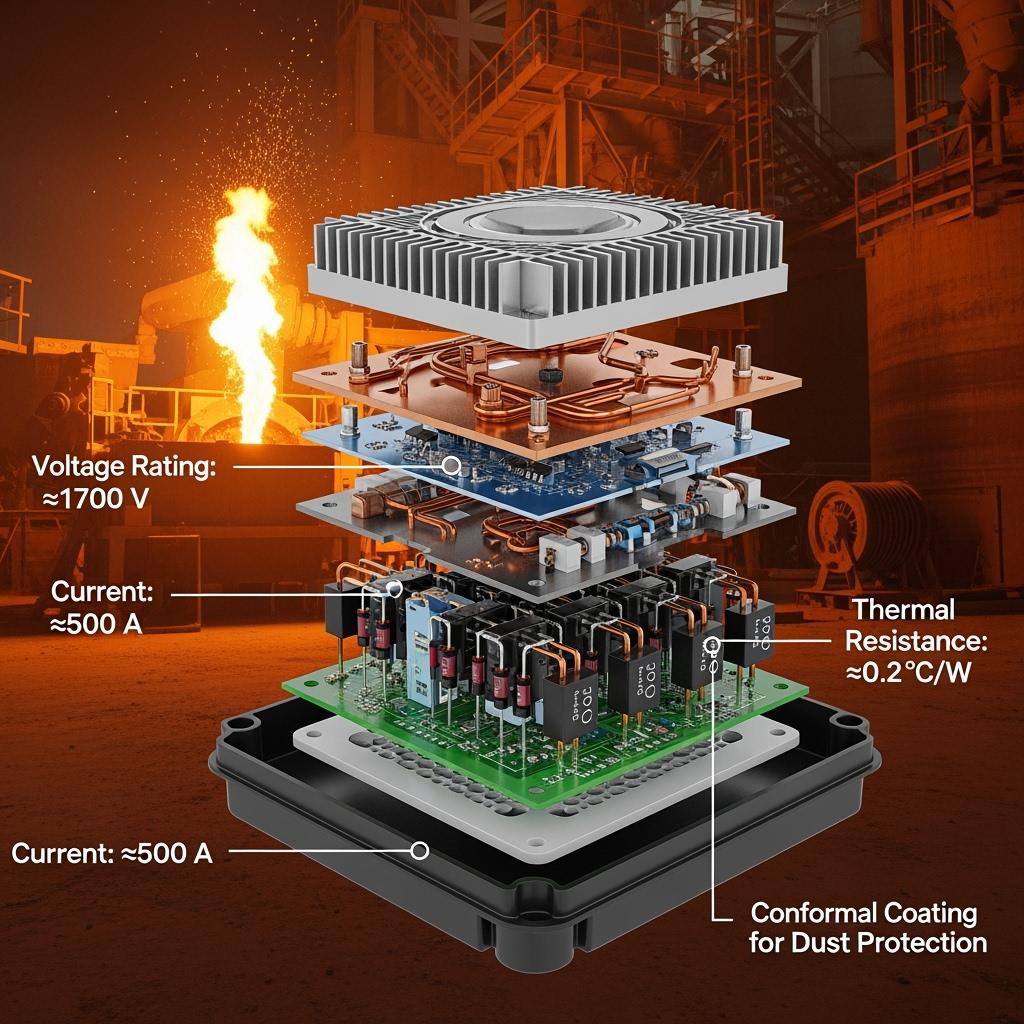
Specyfikacje techniczne i zaawansowane funkcje
- Voltage rating: ≥1700 V (line-to-line rectifier front ends for HV industrial feeders)
- Current capability: ≥500 A per module (scalable in parallel for kA-level systems)
- Switching frequency: 20 kHz–50 kHz for low ripple and compact magnetics
- Temperatura złącza: -55°C do 175°C
- Thermal resistance (module): <0.2°C/W with ceramic substrate and optimized baseplate
- Power density: >8 kW/L, enabling smaller cabinets and cooling skids
- Efficiency: Rectification efficiency >98% in typical industrial duty
- Topologies: Three-phase full-bridge, 12/24-pulse configurations, active front-end options
- Protection: Optimized surge suppression, arcing mitigation, short-circuit robustness, NTC-based thermal monitoring
- Packaging: High-reliability ceramic substrate, corrosion-resistant hardware, conformal coating for high-dust environments
- Communications and control: MODBUS TCP, PROFINET, EtherNet/IP, DNP3, OPC UA for SCADA/PLC integration
- Compliance support: IEC 62477-1, IEC 61000 series, IEC 60747; documentation to support ISO 50001 and ISO 14001 initiatives
Performance and Compliance Advantages for Industrial Rectification
| Atrybut | SiC High-Voltage Rectifier Modules | Conventional Silicon Rectifier Stacks |
|---|---|---|
| Wydajność przy pełnym obciążeniu | >98% z ultra niskimi stratami przewodzenia/przełączania | 90%–94% with higher thermal load |
| Powierzchnia chłodzenia | 30%–40% smaller due to lower losses | Larger heat sinks and higher coolant flow |
| Zdolność temperaturowa złącza | -55°C to 175°C for harsh sites | Zazwyczaj od -40°C do 150°C |
| Wydajność harmoniczna | High-frequency operation reduces ripple, supports multi-pulse | Lower switching speed, higher THD |
| Failure rate in dust/heat | >50% lower with ceramic packaging | Higher due to heat and contamination |
| Interwał konserwacji | Raz na 2 lata | Około dwa razy w roku |
| Dostosowanie do standardów | IEC 62477-1, IEC 61000, IEC 60747 | May require additional mitigation |
| Payback window | 2–3 years from energy and maintenance savings | Dłużej ze względu na wyższy OPEX |
Kluczowe zalety i sprawdzone korzyści z wglądem ekspertów
- Strong current handling: Single-module current in the several-hundred-ampere range meets high industrial loads.
- High-temperature stability: Reliable operation up to 175°C reduces overengineering in cooling systems.
- Low loss and high efficiency: System-level savings of 10%–15% energy annually.
- Environmental robustness: Ceramic packaging and conformal coatings withstand dust, corrosion, and vibration.
- High system integration: Modular designs simplify maintenance and scale-out.
Cytat eksperta:
“Wide bandgap devices such as silicon carbide have redefined efficiency and reliability targets for industrial power conversion, especially where ambient conditions and grid quality are challenging.” — IEEE Power Electronics Magazine, WBG Industry Perspectives (2023)
Zastosowania w świecie rzeczywistym i wymierne historie sukcesu
- Cement and mining rectifiers: In a Karachi clinker workshop deployment, rectification efficiency rose from 92.3% to 98.1%. Annual electricity savings exceeded 120,000 USD, and operating hours increased from 8,000 to 8,760 per year. The installation achieved national industrial energy-saving demonstration recognition.
- Steel EAF and rolling mills: SiC modules stabilize DC bus under grid flicker, reducing drive trips and cutting cooling skid size. Operators report tighter process control and longer component life.
- Textile mills: High-frequency rectifier fronts for VFDs and UPS reduce heat and harmonics, improving loom uptime and lowering HVAC loads in densely packed facilities.

Rozważania dotyczące wyboru i konserwacji
- Environmental class: Select IP rating and coating for high-dust cement/mining environments; consider additional filtration for extreme dust.
- Grid conditions: Configure surge protection, ride-through options, and control-loop tuning for local sags/swells and unbalance.
- Cooling strategy: Liquid vs. forced-air based on ambient temperature and particulate load; verify coolant quality and flow monitoring.
- Integration: Match to existing transformers, busbars, and cabinet footprints; plan interface for SCADA protocols common in Pakistan.
- Maintenance: Schedule preventive checks every 24 months; monitor NTC sensors, connector torque, and coolant condition.
Czynniki sukcesu w branży i referencje klientów
- Success factors: Site-specific harmonic studies, correct thermal margining, phased retrofit strategy to minimize downtime, and operator training aligned to the new switching frequencies.
- Customer voice: “After moving to high-voltage SiC rectifiers, our clinker line saw a sharp drop in heat-related trips and a noticeable cut in electricity bills, improving budget predictability.” — Operations Manager, major cement producer in Sindh.
Przyszłe innowacje i trendy rynkowe 2025+
- Higher-voltage devices: Expansion beyond 1700 V to support medium-voltage front ends with fewer components.
- Integrated intelligence: Embedded diagnostics, digital twins, and predictive maintenance to maximize uptime.
- Local capability growth: Technology transfer and localized assembly/testing to shorten lead times and strengthen skills.
- Sustainability focus: Energy intensity targets and ISO 50001 adoption driving SiC adoption in export-oriented textiles and metals.
Industry outlook reference:
“Industrial SiC penetration continues to accelerate through 2025, driven by system-level cost savings, reliability, and compactness.” — Yole Group, Power SiC Market Monitor (2024)
Najczęściej zadawane pytania i odpowiedzi ekspertów
- Are these modules compatible with existing silicon rectifier cabinets?
- Yes. Mechanical adapters and interface kits allow retrofits while reusing transformers and bus structures.
- What grid issues can they handle?
- Control and protection are optimized for sags, swells, and harmonic-rich feeders; multi-pulse options address power quality goals.
- What lead time is typical for customized modules?
- For standard ratings, 6–10 weeks; customized thermal or control variants typically 10–14 weeks, with expedited options via local partners.
- What documentation is provided for compliance?
- Test reports and documentation aligned with IEC 62477-1, IEC 61000, and IEC 60747; guidance for ISO 50001/14001 conformity.
Dlaczego to rozwiązanie działa w Twoich operacjach
Silicon carbide high-voltage rectifier modules deliver immediate, measurable value in Pakistan’s harsh industrial settings: higher efficiency, smaller cooling systems, and greater uptime under volatile grid conditions. With proven >98% efficiency and extended maintenance intervals, the technology reduces total cost of ownership, aligns with local standards, and supports modernization without disruptive rebuilds.
Połącz się ze specjalistami, aby uzyskać niestandardowe rozwiązania
Unlock faster ROI and higher reliability with a partner delivering end-to-end silicon carbide solutions.
- Ponad 10 lat doświadczenia w produkcji SiC
- Innowacje wspierane przez wiodący ekosystem badawczy
- Niestandardowy rozwój w zakresie materiałów R-SiC, SSiC, RBSiC i SiSiC
- Transfer technologii i usługi zakładania fabryk
- Turnkey delivery from material processing to finished modules
- Proven track record with 19+ enterprises in heavy industry
Get a free consultation, feasibility assessment, and customized ROI model tailored to your plant’s load profiles and environmental conditions.
- Email: [email protected]
- Telefon/WhatsApp: +86 133 6536 0038
Suggested next steps: Share single-line diagrams and load data, schedule a site assessment, and plan a pilot installation with performance guarantees.
Metadane artykułu
- Ostatnia aktualizacja: 2025-09-12
- Następna zaplanowana aktualizacja: 2026-03-31
- References: IEEE Power Electronics Magazine (2023) WBG perspectives; Yole Group Power SiC Market Monitor (2024); International Energy Agency Technology Perspectives (2024)

About the Author: Sicarb Tech
We provide clear and reliable insights into silicon carbide materials, component manufacturing, application technologies, and global market trends. Our content reflects industry expertise, practical experience, and a commitment to helping readers understand the evolving SiC landscape.

Customizable SiC
You May Also Interest
-
![]()
Podłoża SiC: Klucz do postępów w urządzeniach elektronicznych
Podłoża SiC: Klucz do postępu w urządzeniach elektronicznych Wprowadzenie: Kluczowa rola podłoży SiC W szybko rozwijającym się krajobrazie wysokowydajnych zastosowań przemysłowych nauka o materiałach odgrywa kluczową rolę. Wśród zaawansowanych materiałów wyróżnia się węglik krzemu (SiC), szczególnie w postaci podłoży SiC. Podłoża te to nie tylko warstwy podstawowe; są one krytycznymi czynnikami umożliwiającymi…
-
![]()
Innowacje w dziedzinie SiC za pośrednictwem uniwersyteckich łączy badawczych
SiC Innovation via University Research Links W szybko zmieniającym się krajobrazie zaawansowanych materiałów, niestandardowy węglik krzemu (SiC) wyróżnia się jako prawdziwy przełom. Jego niezrównane właściwości sprawiają, że jest niezbędny w szerokim spektrum wymagających zastosowań przemysłowych, od najnowocześniejszych technologii produkcji półprzewodników po ekstremalne środowiska lotnicze i energię jądrową. Ale co…
-
![]()
Płytki SiC nowej generacji dla doskonałości w elektronice mocy
Płytki SiC nowej generacji dla doskonałości w elektronice mocy Wprowadzenie: Kluczowa rola płytek SiC w nowoczesnej elektronice mocy Nieustanne dążenie do wyższej wydajności, zwiększonej gęstości mocy i doskonałej wydajności w systemach elektroniki mocy zwróciło uwagę na węglik krzemu (SiC) jako materiał transformacyjny. Płytki SiC, podstawowe podłoża dla urządzeń mocy na bazie SiC, są w…